

FIFA World Cup 2026 Format

The 2026 World Cup will be the first ever hosted by three countries: the USA, Canada, and Mexico. But that's not all — the biggest change from the Qatar World Cup is the expanded number of participants and the revised format.
Who will win the World Cup 2026?



Key Changes in the World Cup 2026 Format
The decision to expand the number of teams in the final stage of the 2026 World Cup was made back in 2017. The difference from previous tournaments is clear: the number of matches has increased significantly, as well as the potential strain on teams and logistics.
|
|
World Cup 2022 |
World Cup 2026 |
|
Teams |
32 |
48 |
|
Matches |
64 |
104 |
|
Duration (Days) |
29 |
39 |
On one hand, more countries can now qualify for the final stage of the World Cup. However, the spectacle of football, especially in the group stage, may suffer due to the clear difference in quality and level between the teams. For instance, it's hard to imagine anyone outside Haiti or Scotland being interested in watching a match between those two nations at the World Cup.
Logistical challenges also increase significantly given the tournament’s expanded geography.
Group Stage: Why Did FIFA Reject the Three-Team Group Format?
Initially, FIFA had considered reducing the number of teams in each group to three, which would have resulted in 16 groups for the 2026 World Cup.
However, in March 2023, FIFA President Gianni Infantino reconsidered this decision, realizing after the Qatar tournament that traditional four-team groups provided more excitement up until the final moments of the group stage. For example, in Groups C, E, and H at the 2022 World Cup, all four teams were still in contention for knockout qualification up to the final whistle.
2026 World Cup Format and Groups
In the final stage of the 2026 World Cup, there will be 12 groups, each with 4 teams. Every team will play at least three games in the tournament.
All Groups for World Cup 2026
|
Group A |
Mexico |
South Africa |
South Korea |
Czech Republic |
|
Group B |
Canada |
Qatar |
Switzerland |
Bosnia and Herzegovina |
|
Group C |
Brazil |
Morocco |
Haiti |
Scotland |
|
Group D |
USA |
Paraguay |
Australia |
Turkey |
|
Group E |
Germany |
Curaçao |
Ivory Coast |
Ecuador |
|
Group F |
Netherlands |
Japan |
Tunisia |
Sweden |
|
Group G |
Belgium |
Egypt |
Iran |
New Zealand |
|
Group H |
Spain |
Cabo Verde |
Saudi Arabia |
Uruguay |
|
Group I |
France |
Senegal |
Norway |
Iraq |
|
Group J |
Argentina |
Algeria |
Austria |
Jordan |
|
Group K |
Portugal |
DR Congo |
Uzbekistan |
Colombia |
|
Group L |
England |
Croatia |
Ghana |
Panama |
With the new format, the group stage of the 2026 World Cup will be the longest in history — in the first two weeks, there will be up to four matches per day.
The "Best Third-Place Teams" System
In addition to the expanded number of groups, a new "best third-place teams" system has been introduced. Now, not only the top two teams from each group will advance to the knockout stage, but also the eight best third-placed teams.
The third-place teams will be ranked based on the following criteria:
-
Points
-
Goal difference
-
Goals scored
-
Fair play: the fewest yellow and red cards received during the group stage
In the event of a complete tie across all criteria, a draw will be held. The only time this occurred during the group stage was at the 1990 World Cup, when the draw was used to determine the opponents for the Republic of Ireland and the Netherlands in the knockout stage: both teams had identical records, and the Republic of Ireland secured second place following the draw.
As a result, the number of teams progressing to the knockout stage has increased:
-
24 teams that finish first and second in their groups
-
8 best teams from 12 that finish third
In practice, this will likely lead to more cautious play from the so-called "underdogs." A single point or a one-goal difference may become decisive for advancing.
World Cup 2026 Knockout Bracket: Introduction of the Round of 32
The increase in the number of teams progressing to the next round to 32 has led to an expansion of the traditional knockout format — instead of the usual Round of 16, the tournament will now begin with a Round of 32. This change adds more elimination games, which, according to FIFA’s Council, should enhance the tournament's excitement and potential for surprises.
On the other hand, it also increases the number of straightforward matches for the top teams. Given the already demanding club season, this could lead to player injuries and early eliminations for some of the top nations.
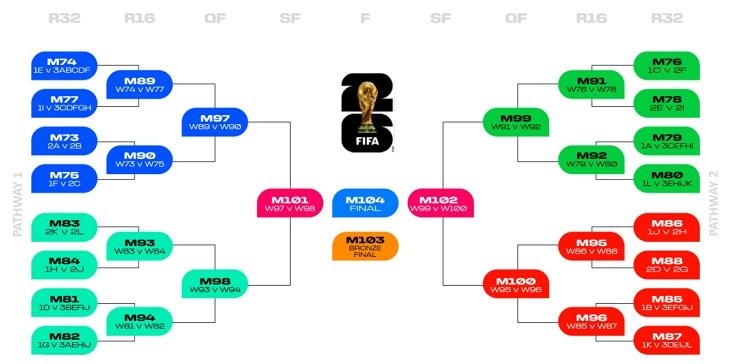 World Cup 2026 Knockout Bracket
The flip side of the potential surprises could be either easy quarter-finals or semi-finals for the top teams that make it through, or simply unexciting matches between teams such as Senegal and Colombia in the later stages of the tournament.
Path to the Final: How Many Matches to Win the Title?
The winner of the 2026 World Cup will need to play eight games instead of the usual seven — three in the group stage and five in the knockout rounds. Since 32 teams will progress to the next stage, favourites won't necessarily need to win every group game — five points will likely be enough to advance to the knockout stage against a relatively weaker opponent.
Given the depth of squads and the strength of the benches for top teams, they will be able to rotate players at the end of the group stage to save their best players for the knockout rounds.
Once again, the question arises about the spectacle: will there be sell-out crowds and high viewership if, in the third round, an unmotivated France without Mbappé faces an unmotivated Norway without Haaland?
Allocation of World Cup Places by Confederation
Gianni Infantino has repeatedly stated that the expansion aims to provide fairer representation of African and Asian countries in tournaments. These regions have become key markets for FIFA in recent years, and increasing the number of slots was a logical step in this process.
Guaranteed places:
-
UEFA (Europe) — 16
-
CAF (Africa) — 9
-
AFC (Asia) — 8
-
CONCACAF (North America) — 6 (including three host nations for 2026)
-
CONMEBOL (South America) — 6
-
OFC (Oceania) — 1
Two additional spots were decided through intercontinental playoffs, with DR Congo and Iraq securing their places in the tournament.
World Cup 2026 Schedule and Host Cities
The tournament will be divided into regional clusters — West, Central, and East. This will slightly reduce the logistical load and optimise travel for the teams.
The majority of the organisation will be handled by the United States, as the highest number of matches will be hosted by American cities:
-
USA: Atlanta, Boston, Dallas, Houston, Kansas City, Los Angeles, Miami, New York/New Jersey, Philadelphia, San Francisco, Seattle
-
Mexico: Mexico City, Guadalajara, Monterrey
-
Canada: Toronto, Vancouver
The tournament will take place in two stages:
-
Group Stage starts on 11 June and ends on 27 June;
-
Knockout Stage begins on 29 June, with the final taking place on 19 July at the MetLife Stadium in the USA (for the duration of the World Cup, it will be called "New York New Jersey" due to FIFA's ban on sponsor-related names).
Conclusion and Analysis: How Will the New Format Affect Spectacle?
The new World Cup 2026 format initially seems like a less successful experiment from FIFA’s Council and Gianni Infantino. It is primarily aimed at generating revenue from American, Asian, and African television markets, but the quality of football is undoubtedly set to decline.
In most of the tournament’s groups, there is a clear favourite, and the competition for third place between Qatar and Bosnia in any group is unlikely to attract much attention, either in the USA or globally.
With the increase in the number of games, there is also a risk of seeing reserve squads from the top teams throughout the group stage, given that most players already play over 70 matches a season.
Potential surprises during the tournament sound exciting on paper, but with more groups and a lower quality of teams, don’t expect to see Argentina’s reserves battling until the final minutes with Jordan for a place in the knockout stage.
The same can be said for the knockout rounds. Fatigue from top teams after an intense club season could indeed lead to upsets in the early stages. This is only interesting as a headline, but the real appeal of a potential semi-final between Norway and Senegal will pale in comparison to a match between France and Germany.
FAQ
No, after discussions, FIFA returned to traditional four-team groups to reduce the risks of match-fixing and the potential lack of drama on the final matchday.
32 teams will progress to the next stage: the top two teams from each group, plus the eight best third-place teams.
The 2026 World Cup will begin on 11 June 2026 and run until 19 July 2026.
Read more:


